 Own it today
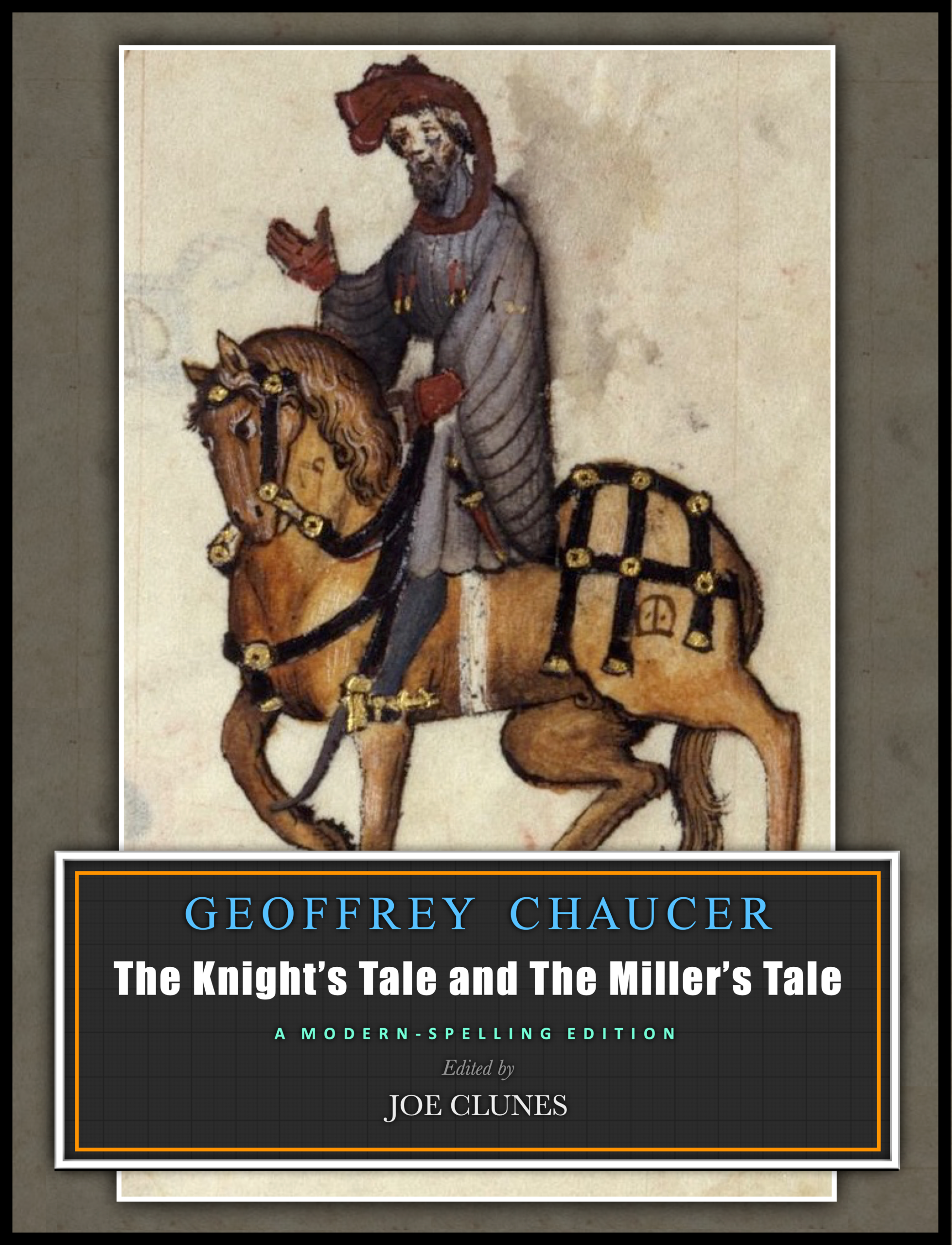
Parallel with the Middle English, this edition of The Canterbury Tales presents a modernised text. Similar to the way that the spelling of William Shakespeare is modernised in today’s editions, these are Chaucer’s same words, updated according to the spelling of the Oxford English Dictionary to make them more recognisable to the reader. Glossarial tooltips have been further provided for unfamiliar words.
The word endings “-n” or “-en” (which have to do with plurality or tense) can be chosen to be largely read over or ignored when starting out with reading Chaucer, for example, “weren” can be understood simply as “were;” “tellen” as “tell;” – “and well we weren eased at best;” can be understood as “and well we were eased at best;” – “Whilom, as old stories tellen us…” as “Whilom, as old stories tell us…”
The transcript and glosses follow The Oxford English Dictionary, available at OED.com (with a subscription), and Wiktionary, which is a very good alternative. W. W. Skeat’s Middle English Glossary (A-D) (E-K) (L-R) (S-Z), and Index of Proper Names were also extensively used, and are available online at Wikisource, as were editions of Chaucer by W. W. Skeat, F. N. Robinson, and Larry D. Benson.
The text (mostly) follows the editorial decisions of W. W. Skeat (1835-1912), and was transcribed from his scholarly edition, published in 1899 by Oxford University Press.